
In a recent interview, Professor Emeritus Stephen Kotkin referred to Ukraine as the “Walmart of defence tech” and wondered aloud why the US wasn’t spending huge sums of money to buy and/or license Ukrainian drone and anti-drone technology. In the last few months, we have seen practically every Gulf Arab state do exactly that. What exactly is the US strategy? The truth seems to be that the current administration has no strategy either in the Middle East or in the Indo Pacific. There are certainly operational plans filling entire wings in the Pentagon, but the one place where there is no cogent strategy in office 2B315, which is the second floor B Ring office of the Secretary of Defense. And there’s the rub.
Let’s quickly review why not having a strategy is problematic. The pyramid blew demonstrates how each intellectual data set becomes the basis for the one above it. For our discussion today, let’s begin halfway up with strategy.
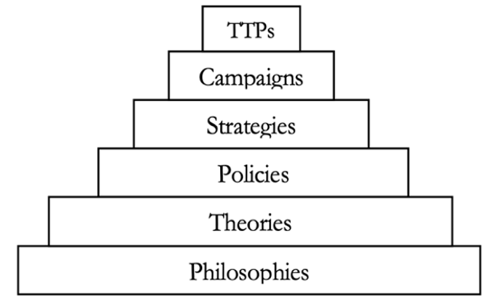
Strategy is a governing baseline for all bellicose action above it and without a cogent strategy, those actions lack cohesion beyond the immediate whim of the person ordering the action. If we were looking for proof of this axiom, we’d need look no further than how the US is pursuing its “action” against Iran — or even Canada for that matter. On Monday the sky is blue; on Tuesday the sky is made of pumpkin spice and on Wednesday, the immigrants are eating all the cats and dogs ….
If we were watching a Monty Python movie, all of this nonsense would be hilarious, but we aren’t. We are watching elected men and women in a country claiming to “lead” the free world because they are the self-proclaimed “best” democracy history has ever seen.
No. Not so much.
We Canadians feel this chaos both more immediately and more deeply than anyone. But what is our strategy? We worked for generations to integrate our economy — and arguably our society — with the US and now we find ourselves in a tightening vise. But it isn’t all doom and gloom. In the same way that America’s insulting defamation of Europe caused the opposite of what was intended. Europe was supposed to wake up and spend more money on defence, which in US minds meant buying more American weapons. Instead, they sat up and spent incredibly more but actually reduced their expenditures on American weaponry. Defence firms across Europe now have full order books and the orders keep increasing. Oops!
The same has happened in Canada. I am in my seventh decade and have never seen this much money being given to the Department of National Defence. The generals are being fire hosed with cash to the extent that they are struggling to spend it all! Further, a decade ago 80% of economy was based on sales to the US; last year it was in the low 70%, and the PM is actively working to push that number DOWN. But unlike the US, Canada is looking around the globe for business deals and defence partners. This week over 100 Canadian defence-related companies are participating in the world’s largest defence trade show (in Poland). Canada is attracting twice as much foreign investment as any other country. For the first time, Canada is the world’s first choice for infrastructure investment. We have the strongest fiscal position in the G7.
Where will all end? The future is unknowable, but historic examples are plentiful that demonstrate that when forced to rebuild economies because of existential threats, nations have frequently risen to the challenge and surpassed expectations. Too many commentators are saying that we need to calm down and simply wait for the next administration to reset the table. That would be a mistake. Our current frictions with our erstwhile best friends and neighbours have awakened us to the parlous position in which we placed ourselves and we now need to ensure that, although we do not do any permanent damage to our generations-long friendships, that we distance ourselves to the point where we can never again be placed in a situation where an American president can present an existential threat.
Like I said, never again.

