
Military leaders have frequently been accused of constantly preparing to fight the last war. I wonder if NATO is not guilty of that sentiment today. Since its inception, the political-military alliance has had as its primary mission, the deterrence of aggression against Europe by the Soviet Union, led by Russia and since 1991, Russia alone.
In mid-May of this year in a post titled Military Thinking and Politics, I made the comment: “I have often joked that the French have been yearning to rule Europe again since the demise of Napoleon Bonaparte. The current American administration may well have handed them their dream. Time will tell.” Earlier this month in a post titled Unintended Consequences, I introduced the keystone principle of war, which is commonly held to be the Principle of the Objective (or in Canada, Selection and Maintenance of the Aim). I would like to link those two comments.
American deprecatory comedians notwithstanding, France has a formidable military. The same is true of Italy, Germany, Poland, Sweden and Finland and quite frankly, just about every member of NATO, (sorry Iceland). According to the NATO homepage, the enduring purpose of the alliance in plain English is to safeguard the freedom and security of all its members. It does this through political and military means. If this were a political science undergraduate seminar, we might consider this purpose to mean that Portugal was being protected from Spain, or France from Germany. But this is not the 17th century, nor an academic discussion. NATO is in place to protect Europe from Russia.
Now let us use a military mental tool: Mission Analysis. Here are the four doctrinal steps:
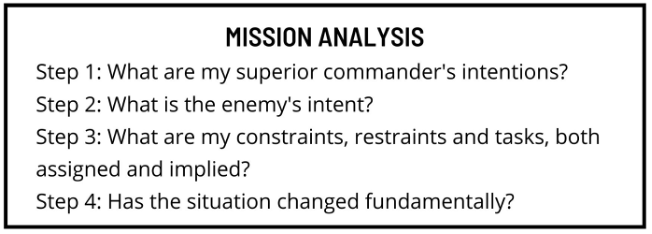
Without going through any verbal gymnastics to apply this process to an organization with 32 sovereign nations, let’s accept that NATO’s mission, as stated, remains valid, that we are fairly convinced that NATO’s only threat comes from Russia, that the constraints and restraints, however arcane and complex, are well understood and implementable. That brings us to the fourth question. Well, has it? Has the situation changed fundamentally?
Unfortunately, in this case the answer is what in German is called “Jaein”. Yes and no. But for the sake of argument (and I believe one could legitimately make this argument) the answer to the question is “yes”. The situation has changed fundamentally. The USSR is buried in the graveyard of civilizations and the rump of that union, Russia, long touted as the second-best army in the world has demonstrated over and again that it is not even the second-best army in Ukraine (hint: there are only two armies there).
So why is NATO trembling at the thought of the USA withdrawing?
There are lots of reasons. Some are political. Some are strategic. Some are economic, and some (many) are emotional. The US has always led the alliance. Yes, and IBM was the world leader in computing until a couple of companies that were started in garages by nerds ate their lunch. Blockbuster “owned” the video market until a quirky startup called Netflix popped up. Nothing is forever. Anyway, we must ask ourselves why we are getting upset that a country that is openly stating it doesn’t want to lead the alliance, might leave the alliance? Would we miss them? Absolutely. They have massive military capabilities, but would Europe be able to defend itself against a serious Russian attack without American assistance?
Ask the French. Allow me to save you the trouble: Oui! The combined strength of current NATO armies DWARFS what the Russians can field. Further, two of the mightiest armies in the Alliance don’t even have to deploy to strike the Russians. They sit on Russia’s western border. If the US were to withdraw tomorrow, NATO would still have over two million military personnel at their disposal and if Ukraine were to join, that would put it over three million, which is where it currently exists with the US.
I know what some of you might be thinking. What about nukes? Even without the US, NATO has not one but two nuclear militaries capable of strategic strikes (France and Britain) but let us not discuss nuclear war, for there are no winners in such a conflict — whatever the size.
And that takes us back to my question: Is NATO fixated on fighting the USSR? It was pretty clear in 1949 that the Soviets could have overrun Europe unless the Americans were stationed there to protect it. But is it still true? Not at all. Europe has never been so strong, nor has it ever been so united. Having the world’s largest military and strongest economy on your side is certainly not a bad thing, but what if they are bullies and refuse to promise to assist you?
Allow me to close with an analogy at a more local level. Everyone wants to live in a peaceful neighbourhood, but what if the guarantee of peace were a constant police presence, where they could abuse you verbally and physically without cause, impose a curfew for all citizens irrespective of age, or intent to go out in public, if there were no right to protest or even to gather in public without written permission from the mayor — who by the way was shambolic, incoherent, and made a mockery of reasonable governance. Would you still want to live in that neighbourhood?
Hmmm….
 The Enlightened Soldier
Hi Chuck, Good piece! I do not share your optimism in the ability of European nations to collectively self-organize. I believe that NATO, less the US, is less than the sum of their parts. Concur with your comments regarding the strategic setting. Happy Canada Day! Bob
Yahoo Mail: Search, organise, conquer
LikeLike