
Those of a certain age will recall a book from the 1970 called Future Shock. In the book husband and wife American futurists Alvin and Heidi Toffler introduced to their readership the concept of life accelerating. The premise was that society was undergoing rapid change and that for many, it was “too much too fast.” The book was a massive bestseller, and I recall reading it and as a teenager (no, I have not always been a bald, opinionated grump — I was once a young, long-haired opinionated grump) this notion seemed quite correct. Now that I am a septuagenarian, it strikes me as common sense (and I have learned to ignore “futurists”).
We have all experienced the dichotomy offered in the title above. Sometimes as the decision maker, more often as being impacted by someone else’s decision.
Look at the diagram below. It compares a speedometer (red) with a paceometer (white). A quick explanation: We are all familiar with speedometers but what do you note about the white dial? At lower speeds, there is a great saving in time by increasing your speed, but if you are already going very fast, the saving in time is insignificant. If you need to go 10 miles and drive at 10 mph, it takes an hour. Increase your speed to 20 mph and you save 30 minutes. But if you’re already at 80 mph and you increase to 90 mph you only save a single minute.
To a scientist the two scales simply offer the same data in different forms, but looked at from human experience they are significantly different. If you are driving at 80 mph, already dangerously fast, increasing your speed to a stupid 90 mph increases risk, not only to you but to those around you, exponentially while saving almost no time.
So what?
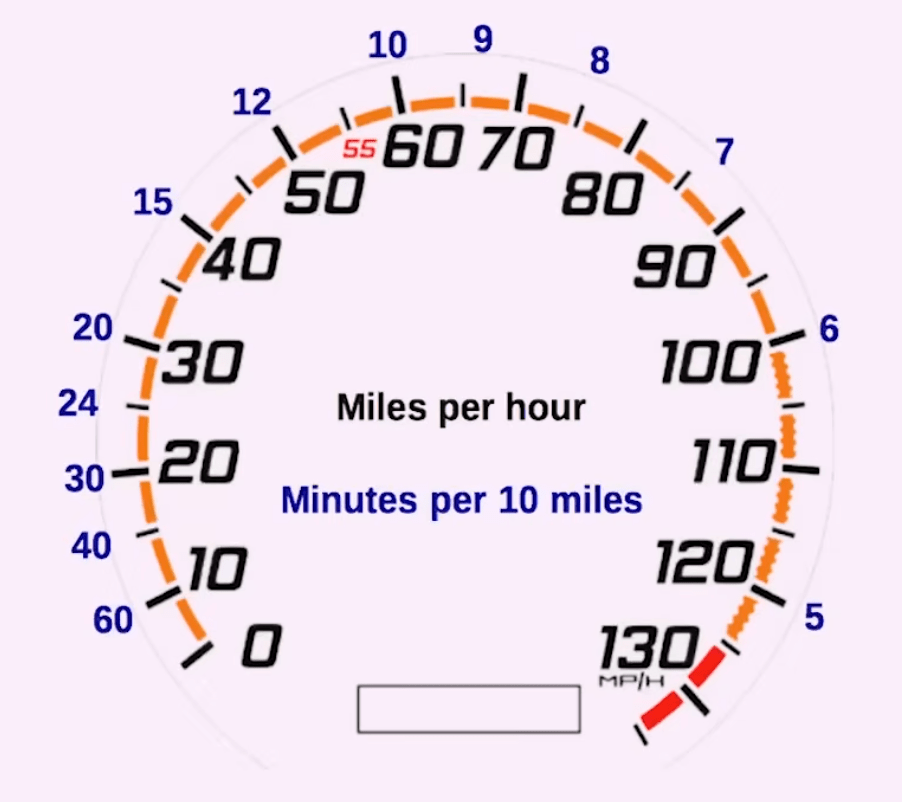
The analogy can offer us lessons in our decision making, whether in daily life, in politics, or in combat. Do not get me wrong. In all these situations, there will be times when we must make snap decisions and perhaps make a series of such decisions in rapid succession. But too often we behave this way when we have no need to do so. When we confuse what is urgent with what is important. Those readers who know me, know that I am a fan of a gentleman called Rory Sutherland, a British marketing guru and (full disclosure) much of today’s post comes from one or more of his lectures. Before discovering Mr. Sutherland, I felt what he described but I didn’t know it. His train examples always strike a chord with me because I lived them.
He points out that all train pricing assumes that we’re in a hurry. But are we? When I worked and lived in Kingston, Ontario, whenever possible I took the train to get to Toronto or Montreal airports. It was “slower” than flying but when you considered the wait times and the comfort and perks of going business class on the train, which was cheaper than flying economy in many cases, it made no sense to fly. I could work on the train while enjoying a drink and a meal. I could stretch or engage in conversation with others or simply wander. You get it.
In an earlier post I spoke about strategic patience, but similar lessons apply at levels below strategic and collectively we seem to have lost the ability to distinguish what is critical and what is pressing. When this inability combines with the Law of Unintended Consequences, we may be looking at disaster. How do we ameliorate this situation? Good question.
If you were expecting a simple solution here, you’re going to be disappointed. There is no simple, one method fits all, solution. But here is a place to start: learn to analyse what you see and consider what may occur based on what you decide. In the military we have a formal process, which we loosely call Branches and Sequels.
That is a good place to begin your journey toward gaining the ability to exercise judgement.
 The Enlightened Soldier