
WARNING: This is arguably one of the most hotly debated — and least well described — concepts in Clausewitz’s writing.
The trinity is central to his analysis of war and defined the constantly changing relationship among:
1. primordial violence, hatred, and enmity,
2. chance and probability, and
3. war’s subordination to rational state policy.
This tripartite and dynamic interplay of violent emotion, chance, and rational calculation wasn’t coincidental. Clausewitz used a religious model to attempt to understand the nature of war. His grandfather was a Lutheran minister and the belief that God was manifest as a trinity was, and is, a central tenet of the Lutheran faith.
What his description of war’s wondrous trinity tries to capture is Clausewitz’s attempt to define how these forces dynamically interplay seemingly — and dangerously — at random, while being irrefutably linked and subordinate to national policy, which is dependent upon rational consideration. This apparent paradox predates both complex system theory and chaos theory as it describes the order within disorder and controlled interplay of forces that is constantly evolving and inherently unstable and therefore unpredictable. (see Geopolitical Predictions 5 Aug, which showed the unpredictability of complex systems.)
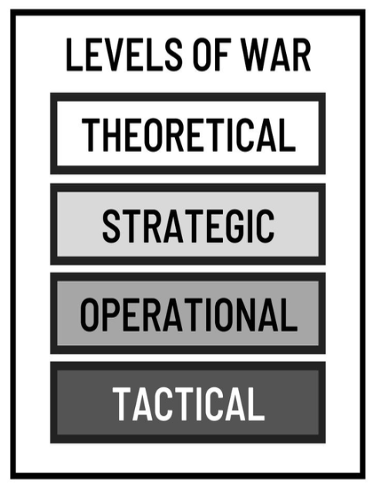
The descriptions above define what is commonly referred to as the Primary Trinity, and confines itself to war at the theoretical level. (see Winning and Losing 30 Sep, which showed the four levels of war.)
This may be interesting to military theory wonks like me, but in terms of political and social science, the so-called Secondary Trinity is more often used (and misused). Clausewitz briefly associated his three intangibles with easily understood factors. He mentions it only once, in the concluding paragraph of Book I Chapter 1. Respectively the three forces manifest themselves in:
1. the people,
2. the military, and
3. the government.
Some will find this paradigm familiar since it has been embraced and enshrined in US Army doctrine, and although I say this with some trepidation, we are now armed to attempt to view the Russo-Ukraine War through the lens of Clausewitz’s trinity. I say attempt because the Secondary Trinity is contentious and can lead some to deep misunderstandings. But this is not meant to be a lecture of military theory, so we’ll push on.
The Secondary Trinity helps us create useful strategies, but at a potential cost. Without understanding the depths of the deeply interconnected spectrum of factors that define war’s nature, it’s easy to create strategies that may appear solid but end in failure. It is for this precise reason that I have always taught the need to understand the four levels of war as opposed to only the traditional three physical levels. This, in my view, is where Russia has erred. The initial strategy was laughably short and after less than a month, had visibly failed. The subsequent strategy appeared to have potential to achieve victory, but soon demonstrated that it, too, was flawed, potentially fatally. It is far too soon to analyse this war at the strategic level, but initial indications seem to point toward some deep and fundamental misunderstandings within both the Kremlin and the Russian General Staff.
Meanwhile, Ukraine seems to be applying a Clausewitzian style Fabian strategy, and it seems to be working. They are strategically shifting to the offence and at the operational levels selectively using an active defence, a so-called defence which is a shield of well-directed offensive actions. The irony of course is that the Ukrainians seem to understand Clausewitz, a former Russian General Staff officer, better than the Russians themselves.
Time to wrap up our two-part investigation of winning and losing. Clausewitz’s trinity merges many of his key insights on war. These include moral force, friction in war, and the linkages between ends and means in achieving victory. The trinity helps us see the difference between war’s nature and its character. As I used to teach, the successful strategist understands and then maintains an equilibrium among war’s three tendencies akin to an iron ball suspended among three magnets, each pulling the ball toward it.
Let’s end by quoting the original author.
War is more than a true chameleon that slightly adapts its characteristics to the given case. As a total phenomenon its dominant tendencies always make war a paradoxical trinity – composed of primordial violence, hatred, and enmity, which are to be regarded as a blind natural force; of the play of chance and probability within which the creative spirit is free to roam; and of its element of subordination, as an instrument of policy, which makes it subject to reason alone.
PS: Can we now answer the titular question? Yes, I believe we can. Ukraine is winning.
 The Enlightened Soldier